The short version
- Four shifts are reshaping how tax firms operate: prep has moved off the senior preparer's desk, errors get caught before filing instead of six months later, small clients are worth taking again, and the CPA hiring pipeline you were counting on has thinned out.
- The firms moving first are doubling down on judgment work and lifting margin on smaller returns at the same time.
- The firms moving slowest are losing on hiring math (CPA pipeline is shrinking, and the existing model assumes a labor supply that no longer exists at the prices firms are used to paying).
- The 2026 picture: AI replaces the transcription work the CPA was doing because nobody else could be trusted with it. Judgment, review, and the signature stay with the human.
Why I'm writing this
I'm a CPA. I ran a Bay Area tax practice for 6 years before I started Juno. Now I host the Modern Tax Pros podcast and talk to firm owners every week about what's working and what's broken inside their practices.
What I'm watching in 2026 is the most significant shift in how firms operate since cloud accounting software arrived 15 years ago. The shape of the firm is changing. Who does what is changing. The economics of which clients to take are changing.
This post walks through those four shifts, with examples from firms I talk to weekly.
What's changing in the CPA profession in 2026?
Four shifts. They reinforce each other, which is why the transition feels so fast at firms that move on all of them at once.
1. How is document processing changing for CPA firms?
The old workflow: a client emails or drops off a stack of PDFs. A preparer opens each one, finds the data points that matter, and re-types them into the tax software. OCR helps with a fraction of the fields. Everything else is manual transcription.
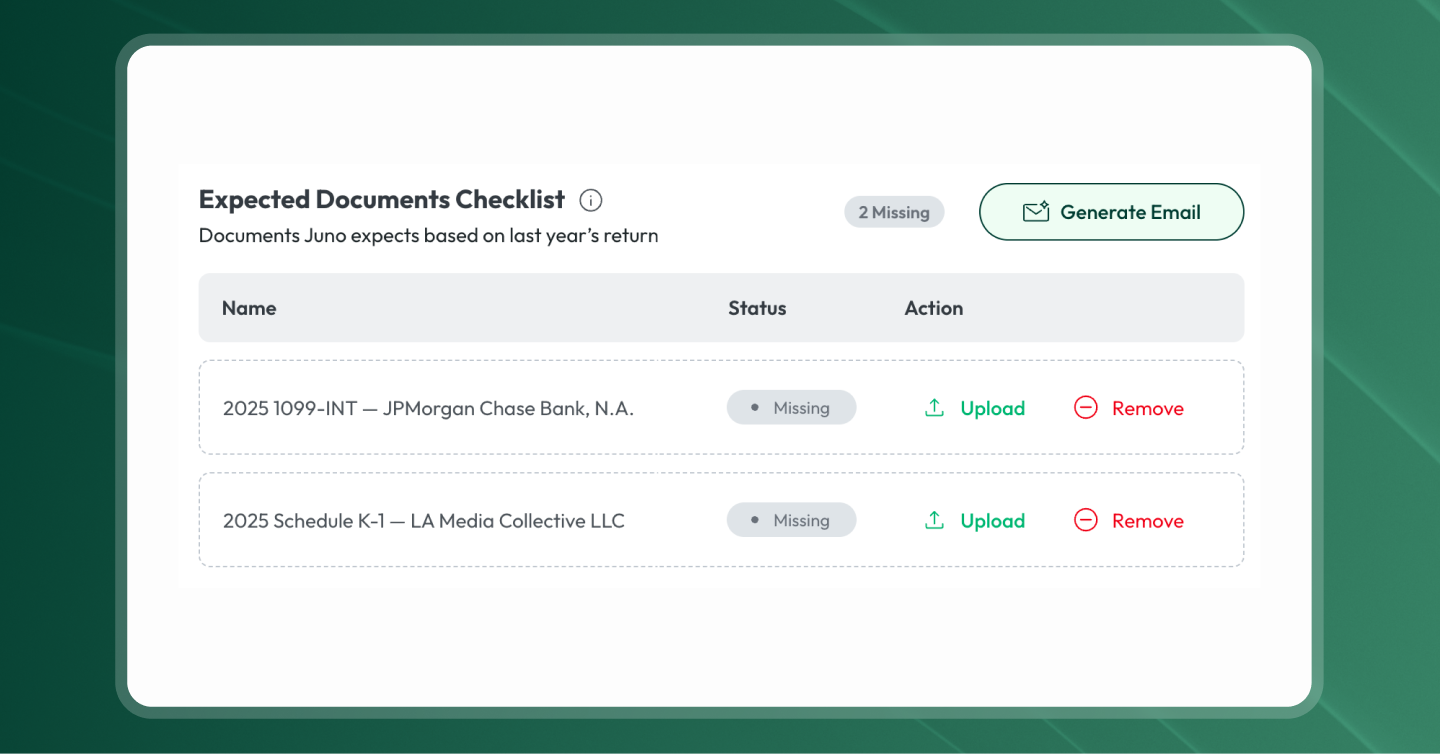
The new workflow with AI tax preparation software: the documents go through the system, the AI extracts about 150 fields per return on average, validates them against the source, and pushes the data into the firm's tax software. The preparer's job shifts from typing to verifying.
The accuracy bar matters here. On the hardest tax documents (multi-hundred-page brokerage statements, scanned paper, K-1s with footnotes and supporting schedules), the latest benchmark is 99.9%+. That number is what makes the next three shifts possible, because if extraction isn't reliable, nothing downstream can change.
David Blain, who runs BlueSky Wealth Advisors in North Carolina and is a Juno customer, framed what this freed up for him personally:
"Juno cuts my research down by 10 to 20x." – David Blain, BlueSky Wealth Advisors
That 10-to-20x is research time he can spend on planning and client advisory work instead of compliance prep. Document processing has stopped being a job in its own right. It now runs in the background while the preparer is doing something else.
2. How are staffing models changing in tax firms?
The traditional firm staffed for tax season by hiring junior certified tax professionals and working them 60-hour weeks for 4 months. That model is breaking on two sides at once. Credentialed hires are harder to come by (the AICPA has been sounding the alarm about the CPA pipeline for years, and the pressure shows up on the EA side too), and the people who are still entering the profession aren't accepting the old work hours.
The new model: admins handle 80-95% of prep. Certified tax professionals pick up at review and judgment. If you want the operational detail, I wrote a deeper post on how this works in practice: What's the admin's role in an AI-powered tax firm?.
The compressed version: AI handles the extraction and validation, an admin runs the checklist, and the certified tax professional's hours go to the parts of the work that always needed one. The math gets better on every dimension. Admins are easier to hire, easier to train, easier to retain. The certified tax professionals the firm does have spend their time on judgment, not transcription.
Tony Amatore, who runs Amatore & Co. with his son Zach and is a Juno customer, described what this looks like on a real hire:
"We took a level-one tax prep person that used to work for a franchise, and by using Juno, we turned him into a very efficient reviewer." – Tony Amatore, Amatore & Co.
At a large franchise, a level-one preparer is largely a data-entry job. At Amatore & Co., with Juno absorbing the extraction and validation, the same person could reliably do reviewer-level work. That's the workforce shift in miniature.
3. How is review and quality control changing?
For most of the history of the profession, errors were caught by the IRS 6 months after filing. A preparer typed a number wrong, the reviewer didn't catch it on the second pass, the return went out, and a notice eventually came back.
With AI tax software running the prep, errors get caught at the source-to-return cross-check stage, before the return is filed. The system compares the extracted value against the value on the source PDF. Mismatches surface inside the tax workflow, not 6 months later.
The reviewer still owns the review. What changes is that the reviewer isn't catching transposed numbers anymore. The reviewer is catching judgment problems: a missing election, a basis question on a K-1, a multi-state allocation that needs facts the client hasn't shared. The transcription errors are gone before the reviewer arrives.
That's a quality bar that traditional firms struggle to match, because traditional firms rely on a senior tax professional's attention catching what a junior preparer's typing missed. It works until it doesn't.
4. How is firm capacity changing in 2026?
This is the shift that surprises firm owners most. The conventional wisdom for a decade has been: fire the bottom 20% of your client list and chase higher-margin work. That advice assumes the smallest returns cost too much to serve relative to what you can charge for them.
With tax prep automation handling the work that used to make small returns unprofitable, the math reverses. The smallest returns become some of the highest-margin work in the firm. A 1040 with two W-2s and a 1099 stops being a hassle that needs a senior preparer's attention. It becomes a 15-minute return at a real margin.
I'm watching firms pick up clients they used to turn away. Evening hours. Walk-in returns. Niche populations that used to be too cost-intensive to serve. The capacity question for 2026 owners changes shape: firms stop asking how many returns their preparers can handle and start asking how many clients they want to take.
Rocky Lippold, who owns Freedom Accounting and Tax in Southwest Missouri and is a Juno customer, is running the inversion of the fire-your-bottom-20% playbook:
"I'm thinking about a couple nights a week staying open later and picking up some of these returns that we've kind of shunned." – Rocky Lippold, Freedom Accounting and Tax
Small returns aren't a low-margin hassle anymore. They're returns the firm can genuinely serve at a real margin.
What does this mean for firms that haven't adopted AI tax software yet?
Three things, in priority order.
The hiring math is the urgent one. If your firm's growth model depends on hiring more preparers, and the credentialed-preparer pipeline keeps tightening, the model breaks before the technology question matters. Firms that have moved to admin-led prep aren't competing for senior preparers in the same way.
The capacity math is the surprise. The clients you've been turning away because they don't fit your margin model are clients other firms are starting to pick up profitably. The competitive base broadens at the small end of the market, not the top.
The judgment math is the long-term one. As extraction gets automated, the differentiation between firms moves to professional judgment. What does your firm uniquely do well? What advice is your team known for? The firms that win the next decade build their differentiation on work AI can't do, while the rest compete on work AI is already doing.
For the deeper mechanics on how AI tax preparation works under the hood, read What is AI tax preparation?.
How AI is changing the CPA profession FAQ
Will AI replace CPAs?
The professional judgment, the signature, the review, the client relationship: none of that gets replaced. What gets replaced is the transcription work the CPA was doing because nobody else could be trusted with it. The job becomes more human, not less.
How fast is adoption happening?
Fast at the smallest firms (1 to 5 preparers, where the founder is the decision-maker) and fast at the largest firms (top 100, where capacity pressure forces it). Slower in the middle, where firm owners are weighing the operational change against the comfort of a workflow that mostly works. The middle is where the gap is widening.
What kinds of firms are leading?
Two archetypes. Solo or small firms run by tech-curious owners who can change their workflow without committee approval. And firms whose growth model already required scaling capacity faster than they could hire. Both groups had a forcing function. Firms without one tend to drift.
What kinds of firms are falling behind?
Mid-size firms with legacy workflows, partner consensus required for change, and no immediate capacity pressure. The advice I'd give those firms is simpler: test it on five returns this extension season and see what you find.
Ready to see how AI tax software changes your firm's returns?
Start 5 free preparations of AI tax preparation software built by a CPA, trusted by 1,000s of tax pros.
7-day trial. No credit card required.
Curious what Juno's AI tax prep could do for your firm? Built by a CPA, trusted by 1,000s of tax pros. Book a demo.