
The short version
- AI tax preparation is the use of AI to extract, validate, and prepare tax return data from source documents (W-2s, 1099s, K-1s, brokerage statements, P&Ls, balance sheets, and more), with a CPA or EA reviewing and signing the return.
- It is not "AI files your taxes for you." It is "AI does the data-entry and verification step that used to take a senior preparer 1+ hour per return."
- Juno's AI tax preparation software reads 100+ document types, extracts ~150 fields per return on average, and brings Juno's processing time to around 10 minutes per return.
- The professional still reviews, still signs, still owns the judgment calls. The grunt work goes away.
Why I'm writing this
I'm Dave Haase. I'm a CPA. I owned and ran a Bay Area tax practice for years before I started Juno. I built Juno because the work my team was doing at 11pm during busy season wasn't tax work. It was typing numbers from PDFs into a tax program, and it was killing the team.
I also host the Modern Tax Pros podcast, where I talk to firm owners about how this category is changing their practices.
This post is the definitional one: what AI tax preparation actually is, what it does inside a firm, what it doesn't, and what the workflow looks like from the inside.
The direct answer to what AI tax preparation is
AI tax preparation is the use of AI to read tax-return source documents, extract the relevant fields, validate the data against the rules of the form, and push the prepared data into your tax software, where a CPA or EA reviews and signs the return.
The work the AI does is the work that used to fall on a junior preparer: opening a stack of PDFs, finding the right boxes on the right forms, typing the numbers into the tax software, double-checking against last year's return. That work is now the AI's job. The work the human does is what tax pros are actually trained for: reviewing the return, asking the client follow-up questions, making the calls that require professional judgment.
Inside Juno specifically, that looks like 100+ document types supported across individual and business returns (including P&Ls and balance sheets), ~150 fields extracted per return on average, and Juno processing time of around 10 minutes per return. Direct push to Drake, Lacerte, ProConnect, CCH Axcess, and more.
What AI tax preparation is not
A few things people sometimes assume, and shouldn't:
- It is not consumer tax software. AI tax preparation in this sense is professional software for CPA and EA firms, not a TurboTax replacement.
- It is not "AI signs the return." The reviewer signs. The professional owns the return.
- It is not a chatbot. It is a data-extraction and validation system that produces a structured, reviewable return in your tax software.
- It is not a replacement for human judgment. AI tax prep automates the grunt work: extraction, validation, data entry, workpaper generation. The professional decisions a CPA or EA gets paid to make stay with the human.
How AI tax preparation works in practice
The workflow inside a firm using Juno tends to look like this:
- Client uploads source documents to the firm's practice management portal (TaxDome, Karbon, Canopy, Firm360, or wherever the firm collects organizers).
- Documents flow into Juno. Either an admin pulls them in manually, or Juno's practice management integrations move them in automatically.
- Juno extracts the data. 100+ document types, ~150 fields on average per return. W-2s, the 1099 family, K-1 page-1 fields and most state pages, brokerage statements, mortgage interest, retirement distributions, Social Security, business return docs like P&Ls and balance sheets, the full mix.
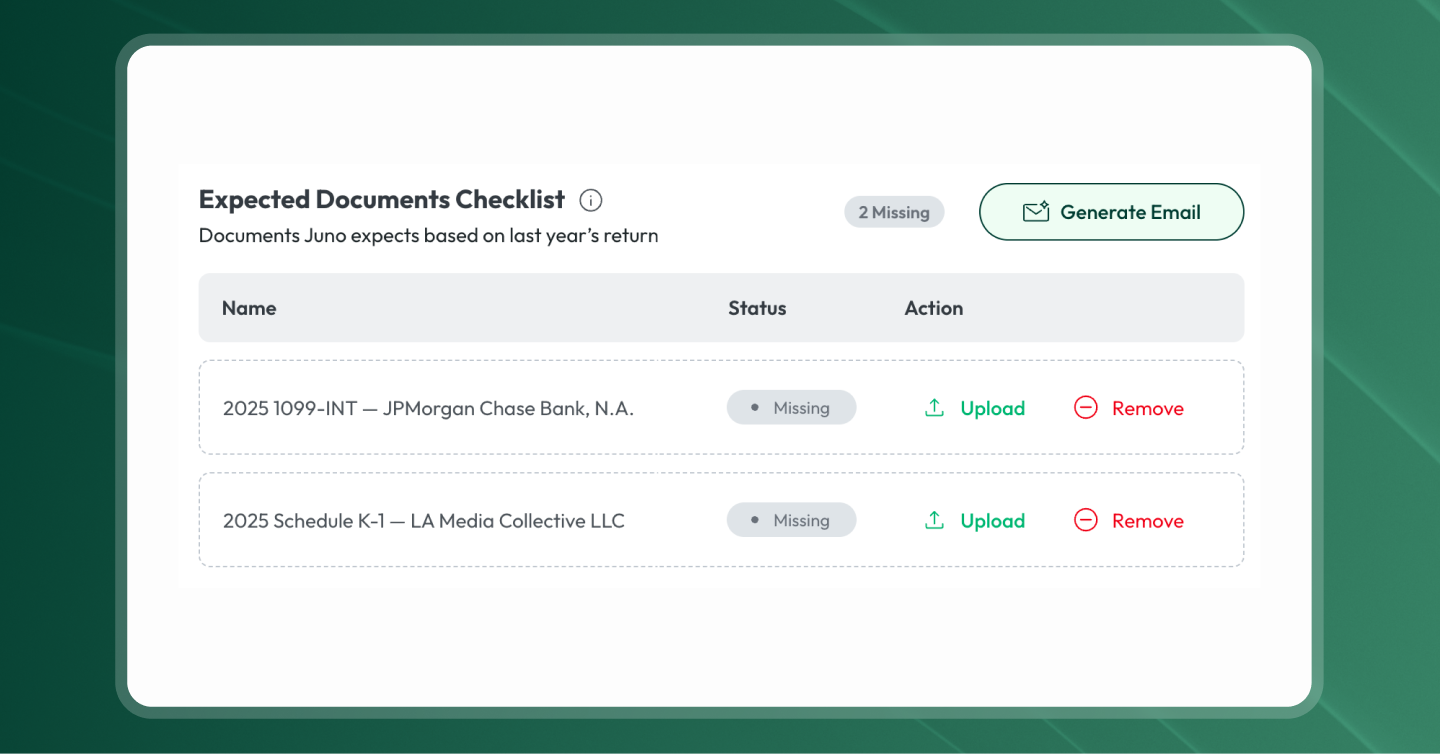
- Juno validates source-to-return. Each extracted value is tied back to the page and line where it came from. Low-confidence reads are flagged for human verification.
- Juno generates the binder. The workpaper PDF is produced automatically, with every source value tied back to its origin page. No more separate manual workpaper step.
- Push to tax software. Juno pushes the extracted, validated data into Drake, Lacerte, ProConnect, CCH Axcess, or another professional tax program.
- The senior preparer reviews and signs. Judgment calls, professional responsibility, the final read. All human.
That's the loop. The shift inside the firm isn't speed alone (though it is faster). The shift is who does each step.
What changes inside a firm using AI tax preparation
Admins can run prep
Once the data entry stops being a tax-knowledge task, the people in your firm who handle scheduling, billing, and client communications can run prep. They're not making tax decisions. They're moving returns from "documents arrived" to "ready for a reviewer."
Inside my own firm, Golden State Accounting, our operations lead Mili Borzini, who joined without a tax background, runs the front end of every return:
"Juno pretty much does all my work for me. It uploads everything, it validates everything, and then you just send it off into our tax software system."
Mili Borzini, Operations Lead, Golden State Accounting
A return takes Mili 15 minutes to an hour, depending on document load. That used to be a senior preparer's job.
Reviewers stop being the bottleneck
When the data is already extracted, validated, and pushed into the tax program, the reviewer is no longer also re-doing the prep step. The review stops being a from-scratch audit and becomes the judgment work it should always have been.
Brad Wooten of Wooten CPA PLLC in Orlando, evaluating Juno against the alternative of hiring a $20/hr intern:
"It's completely different picking that return up as a reviewer than as a preparer. If I can get a review process before me, checking for the transposed numbers and easy stuff, my review goes from 45 minutes to 20 minutes."
Brad Wooten, Wooten CPA PLLC
Per-return economics change
Joel Yaeger of CMPD Wealth Advisory Tax, a Juno customer, on what changed at his firm for retiree returns:
"The CPA is spending twenty minutes instead of an hour and a half."
Joel Yaeger, CMPD Wealth Advisory Tax
Same return. Different role doing the work. The math on hiring versus adding capacity through tools shifts when a 20-minute reviewer pass replaces 90 minutes of senior-preparer time.
Admin staff handling 90% of prep is realistic
Across the firms I talk to, the most consistent operational shift is that 90% or more of the prep work moves to admin staff. The senior preparer's time goes to review, planning, and the complex returns that actually require their experience. That's the load redistribution AI tax preparation enables.
Zach Amatore of Amatore & Co. in Ohio, a Juno customer:
"We brought on a new hire and within the first week they were pushing 8-10 returns a day. That's unheard of without Juno."
Zach Amatore, Amatore & Co.
Who AI tax preparation is for
AI tax preparation is built for professional tax firms. That usually means:
- CPA firms running individual returns, S-corps, partnerships, or a mix.
- EA firms handling representation and prep work.
- Wealth advisory firms with an integrated tax practice (Joel's CMPD and David Blain's BlueSky are both examples).
- Solo practitioners who want to take on more returns without hiring.
- Niche firms serving self-employed and gig-economy clients, where per-return economics have to stay tight.
It is less of a fit for firms that have not yet documented their workflow. The tool magnifies process. A messy intake plus AI extraction plus a messy review still produces a messy return. Get the upstream clean first.
What AI tax preparation doesn't change
Worth being honest about:
- The reviewer still signs. AI does not assume professional responsibility for the return.
- Complex K-1s, footnotes, and adjustments still need human attention. Juno extracts what it can confidently extract and flags the rest.
- Schedule A receipts, handwritten notes, and ambiguous documents still require judgment. The AI surfaces what it sees; you decide.
- Document collection is still a relationship. AI tax prep handles the prep step after the docs arrive. Chasing organizers is your practice management tool's job.
- Tax planning is still the human's work. AI helps research scenarios and surface options. The advisory conversation is still the CPA's.
The mental model: AI removes the grunt work. It doesn't remove the professional.
AI tax preparation FAQ
Can AI prepare tax returns?
AI can prepare the data-entry and validation portion of a tax return: reading source documents, extracting fields, mapping them to the right forms, generating the workpaper, and pushing the data into a professional tax program. A CPA or EA still reviews and signs. So "yes" with the important caveat that the AI is the prep step, not the entire return.
Is AI tax preparation accurate?
AI extraction accuracy on professional-grade tax data is high but not 100%. Juno is in the 95-99% range on most document types, with low-confidence reads flagged for human verification. The model assumes a human reviewer catches what the AI doesn't. That's the same risk model professional firms have always operated under, just with a much faster first pass.
What tax software does Juno work with?
Drake, Lacerte, ProConnect, CCH Axcess, and more. Juno pushes the extracted data directly into the return inside your tax program. It doesn't replace your tax software; it sits in front of it and handles the data entry step.
How long does AI tax preparation take per return?
Juno's processing time per return is around 10 minutes from "documents in Juno" to "data ready in your tax software." The human time on top of that is verification of low-confidence fields and the reviewer's pass. Returns with heavy K-1 volume or long brokerage statements take longer. Retiree returns with a 1099-R and a Social Security statement take less.
Will AI tax preparation make my firm less professional?
In practice, the opposite. AI handles the data entry that used to fall on the most experienced people in the firm during the worst hours of the year. The CPA gets their time back for review, planning, and client relationships, the parts of the job that are actually professional. Several firms I talk to have reported that adopting AI made the work feel more like accounting again and less like data entry.
Ready to see what AI tax preparation looks like on your firm's returns?
If you're evaluating AI tax preparation software, the test that matters is what happens to your team's hours during the upcoming busy season, and what your reviewers spend those hours on. Juno is tax prep automation built by a CPA, trusted by 1,000s of tax pros.
7-day trial. Start 5 free prepartaions. No credit card required.
Curious what Juno's AI tax prep could do for your firm? Built by a CPA, trusted by 1,000s of tax pros. Book a demo.